miércoles, 17 de septiembre de 2014

domingo, 14 de septiembre de 2014
Day 1, 2 languages: Spanish starts at Park Elementary
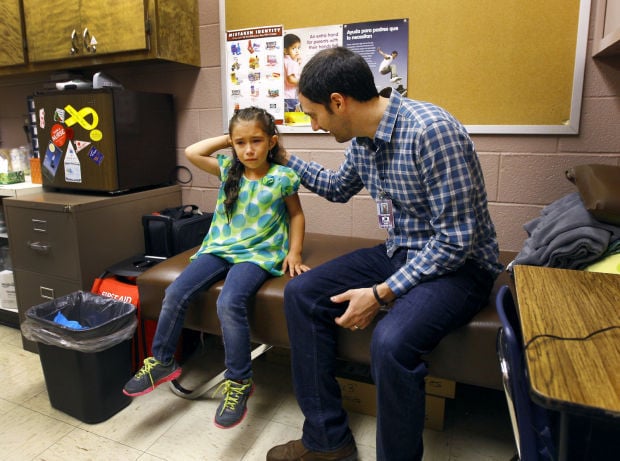
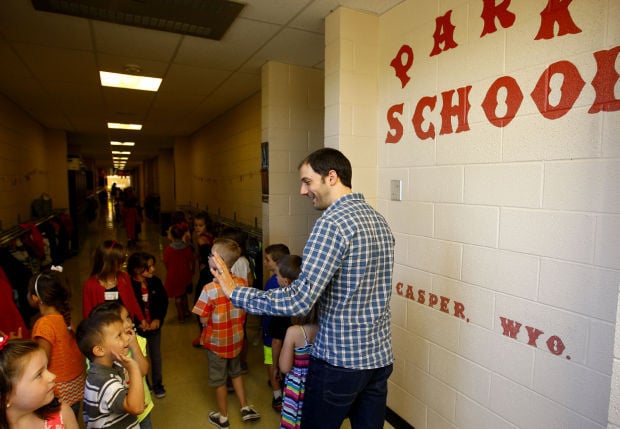
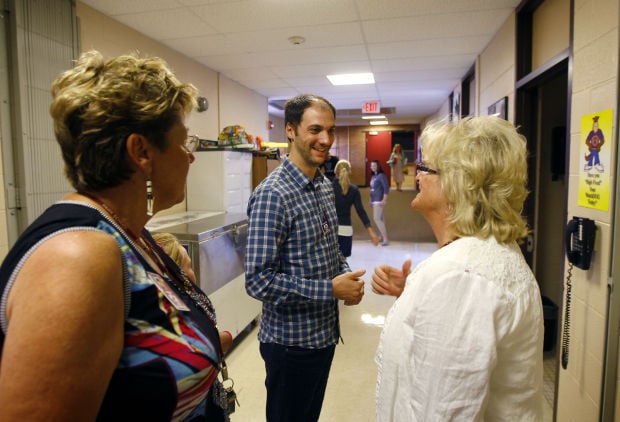
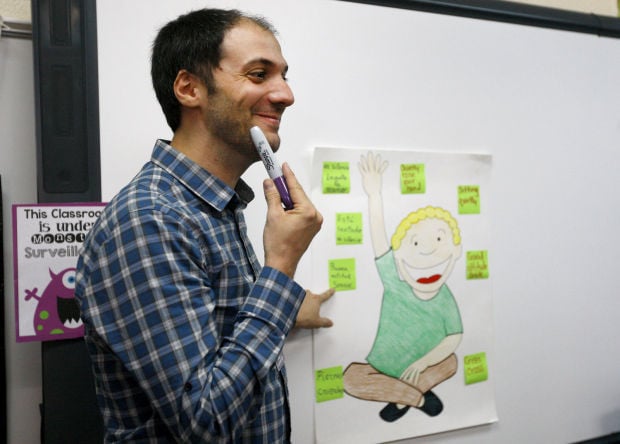
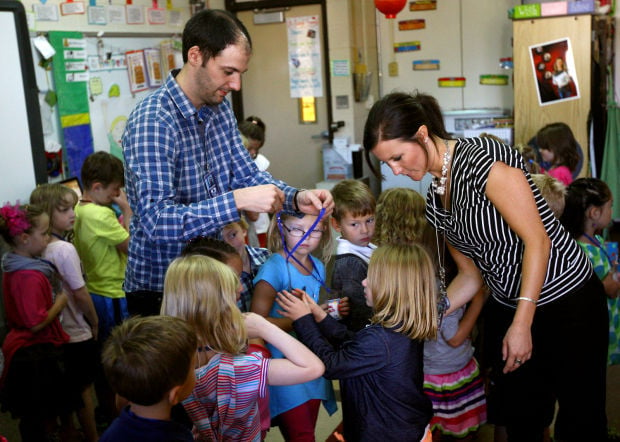
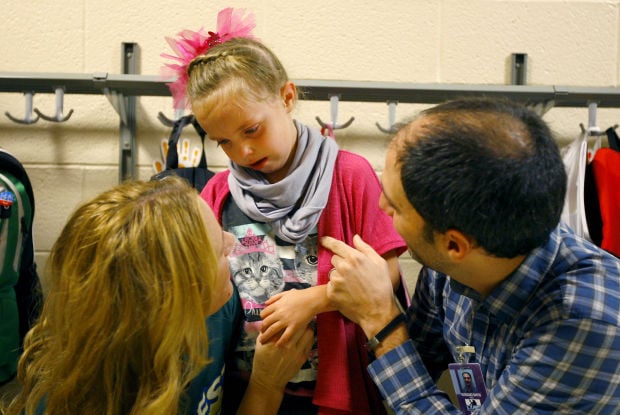
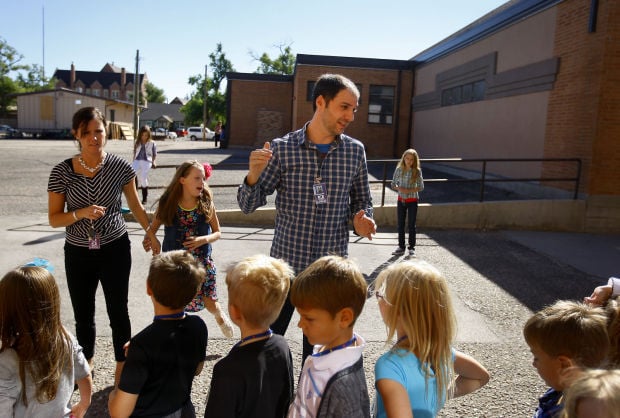
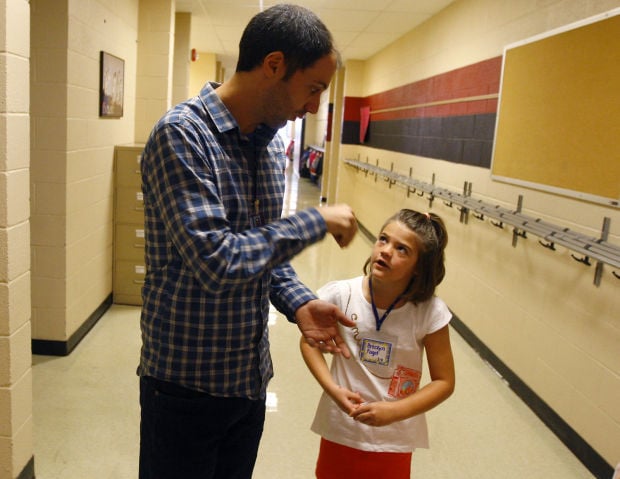


Dual language immersion teacher Saul Rodriguez motions and gestures while speaking Spanish during class with kindergarteners and 1st-graders on Tuesday morning at Park Elementary School in Casper. (Dan Cepeda, Star-Tribune)
A smiling Saul Rodriguez, 33, greeted Spencer Mosley on Tuesday morning outside his classroom at Park Elementary School.
In halting Spanish, Mosley, the school's counselor, asked Rodriguez what students should call him -- Mr. Rodriguez? Senor? Then he introduced his son, Luke, who stood at his side.
"You can say hello; just remember he only speaks in Spanish," Mosley told Luke. "Can you say, 'Hola?'"
"Hola," Luke said, shaking Rodriguez's hand.
Outside, nervous parents hovered around equally nervous kindergartners. Some filmed and photographed their children on iPhones. Many followed their kids through the building as Rodriguez and his partner teacher, Nicole Dundas, 31, hustled children onto a carpet and opened a book written in Spanish and English. A few parents cried.
For Park, Tuesday wasn't an ordinary first day of school. It also meant the first day for the school's new Spanish dual-language immersion program, where some kindergartners and first-graders will learn in English half the day and in Spanish the other half. The school received $15,000 from the Wyoming Department of Education to help start the program this year. It is the second dual-language program in Casper.
Rodriguez, the Spanish instructor, arrived in Casper from his native Spain three days ago.
The cars here are big, he said. And the streets are wide open.
***
Like many elementary students' first days of school, more time was spent on classroom housekeeping -- like sorting school supplies and learning to sit still -- than on reading, writing or arithmetic in Rodriguez's classroom Tuesday.
Dundas called directions in English to the multi-aged class. Rodriguez often repeated them in Spanish.
He spoke quiet Spanish once to a curly-haired blonde girl, whose open pencil box was still sitting on her table after her classmates' had been put away.
The girl looked up at him once eagerly, trying to comprehend his words.
Rodriguez repeated the Spanish word for pencil box -- "caja" -- and pointed to Dundas' desk, where the other pencil boxes were stored.
The girl looked down at her pencil box, back up at Rodriguez and nodded. She rose from her chair, clutching her box, and set it gently on the pile nearby.
Students will probably not understand much at first, said Dawn DeWald, the school's principal.
But come back to school tomorrow and you'll know more, she told Rodriguez's students as they toured the school Tuesday.
"By Christmas, more. And Valentine's Day, more," DeWald said. "Just keeping listening."
Park has a history of weaving Spanish into its school culture. The school employs another full-time traditional Spanish teacher and has offered about 90 minutes of Spanish instruction a week to all its students for more than a decade.
At Park, students recite the Pledge of Allegiance first in English then in Spanish each morning. International flags hang in one hallway. On a wall near the school's entrance, big block letters spelling "Bienvenido" and "Welcome" greet students. Some parts of the building are decorated with laminated Spanish words -- "la Oficina," for instance, hangs over the office door.
The dual language immersion program takes Spanish instruction to a new level. It immerses students in the language; they learn math and science in Spanish.
For Mindy and Brian McCarthy, the dual-language class is a chance to enhance children's natural cognitive abilities. Their daughter, Brynn, 5, is a student in Rodriguez's class this year.
"They're like little sponges at this age," Mindy McCarthy said. "We wanted to give her every opportunity to grow and explore."
The McCarthys don't speak Spanish at home.
"Just Dora the Explorer," Brian McCarthy said.
But they are looking forward to learning with their daughter, who they hope will teach her family what she learns in school each day, Mindy said.
***
Nothing interrupted Rodriguez's happy calm on Tuesday.
Together, Rodriguez and Dundas fielded lost sweatshirts, finicky nametags, more than one lonely 5-year-old away from Mom and Dad for the first time and a playground bump that landed a girl in the nurse's office.
By the end of this week, the pair's schedule for the multi-aged classroom will return to normal. Half the group will spend the morning with Rodriguez, learning math and science entirely in Spanish, the other half with Dundas learning English literacy. In the afternoons, they will switch. Dundas will reinforce and supplement in English what Rodriguez teaches them in Spanish, she said.
At times Tuesday, the teachers struggled to communicate. Dundas speaks virtually no Spanish.
"I'll just have to learn," she said.
In the meantime, Rodriguez relies mostly on gestures and repetition to communicate with Dundas in front of the students.
Tuesday, it worked.
The two also devised a system to communicate in case of necessity; Rodriguez can write English phrases on a notepad kept on the ledge between his classroom and Dundas'. And in an emergency, of course, Rodriguez can speak in English, Dundas said.
"It's important [for students] to see him as speaking only in Spanish," said Dundas, who volunteered to teach with the dual-language immersion program this year and has a 4-year-old son she hopes will make the class next fall.
Students will work harder at learning the language that way, she said. If they don't know he speaks English, they are less likely to take the easy way out by responding in their native language.
Eventually, though, students will figure out that Rodriguez speaks English.
Dundas hopes that will help them see it is possible for them, too, to learn more than one language.
Soon, certain words will become familiar and begin to stick out from Rodriguez's lilting Spanish. What sounds like a verbal gush of water from an open spigot will slow down for the children. Their little brains will recognize words and phrases -- like "elefante," "Abuelo," "frijoles" -- within the flow of fast sentences. One day, they will craft Spanish sentences of their own.
But for now, Rodriguez doesn't pay any mind to the blank stares and slow reactions when he speaks in Spanish.
It's only the first day of school, after all.
One day down. One hundred and seventy-four to go.
sábado, 13 de septiembre de 2014
Capturando a la luz en estado solido

Un equipo de físicos de la Universidad de Princeton ha logrado obligar a la luz a que se comporte de manera realmente extraña. En lugar de desplazarse a su velocidad normal, han conseguido que se detenga formando estructuras similares a cristales.
No es la primera vez que se logra "congelar" la luz. En julio del pasado año, investigadores de laUniversidad de Darmstadt, en Alemania, lograron detener la luz durante un minuto utilizando entrelazamiento cuántico. En septiembre de 2013, científicos del Centro de Átomos Ultrafríosque gestiona a medias el MIT y la Universidad de Harvard fueron los primeros en lograr que las partículas de luz se agruparan formando una estructura similar al cristal. Lo hicieron sometiendo los fotones a temperaturas cercanas al cero absoluto.
Ahora, el equipo de Princeton ha llegado al mismo punto, pero mediante una técnica sutilmente diferente. De nuevo, han recurrido al entrelazamiento cuántico. Los físicos de Princeton han creado una máquina formada por miles de millones de átomos superconductores alineados para que se comporten como un único átomo artificial. Después han situado este átomo junto a un cable superconductor por el que circulan fotones.
Por la propia mecánica cuántica, los fotones tomaron algunas de las cualidades del átomo artificial y comenzaron a interactuar entre ellos como si tuvieran masa. En este estado, el equipo logró que los fotones fluyeran de manera similar a un líquido, o se detuvieran formando estructuras sólidas.
Por ahora, el tamaño de estas interacciones es muy pequeño, pero los investigadores confían en aumentar la escala y seguir estudiando como controlar la luz para que adopte diferentes comportamientos. En el futuro, la técnica quizá podría llevar al descubrimiento de superfluidos o aislantes con propiedades aún desconocidas. También permitirá entender mejor la computación cuántica. [Physical Review X vía Science Blog]
Mientras tanto...
Los profesores de física Mikhail Lukin y Vladan Vuletic estaban experimentando con fotones cuando han logrado algo que hasta ahora se consideraba imposible: crear una molécula de fotones.
Que descubran una nueva forma de materia basada en luz ya es de por sí una noticia increíble, pero que ese nuevo estado abra las puertas a la creación de un sable láser como los de La Guerra de las Galaxias ya supera nuestros más locos sueños. Ha ocurrido, y sus protagonistas son dos científicos del Centro de Átomos Ultrafríos que gestiona a medias el MIT y laUniversidad de Harvard.

Hasta ahora se consideraba que los fotones eran partículas sin masa que no interactuaban entre ellas como lo hacen las partículas que sí tienen materia. Por poner un ejemplo práctico, si cruzamos dos haces de luz como dos láser, estos simplemente se atraviesan. Al no tener masa, los fotones tampoco se unen en estructuras más grandes como hacen otras partículas.
Lukin y Vuletic han creado un medio en el que los fotones actúan como si tuvieran masa y se unen formando lo que ellos llaman moléculas fotónicas. La comparación con los sables de luz no es casual. Ambos investigadores explican que estas moléculas se atraen y repelen como lo hacen los átomos con masa, o sea, que dos hipotéticas estructuras de moléculas de luz se detendrían una a la otra como hacen los sables láser.
Para lograr esta extraña nueva forma de materia hecha de luz, los investigadores utilizaron frío. Los fotones fueron introducidos en una cámara de vacío con una nube de átomos de rubidioenfriada hasta casi cero absoluto. Al paso por esta nube, los fotones se ralentizan y, si se disparan varios, salen de la cámara unidos como en una molécula. La causa física de esta unión se basa en la denominada Constante de Rydberg. Mediante este procedimiento, los investigadores no dudan en afirmar que se podrían crear estructuras tridimensionales de luz
Lo trágico (desde el punto de vista Nerd) es que el equipo de Lukin y Vuletic no está interesado en fabricar sables de luz. El descubrimiento funciona como una puerta lógica de fotones, y sienta una base nueva y estable para el desarrollo de la computación cuántica. Aunque no vaya a haber armas jedi, sigue siendo un descubrimiento formidable. [Nature vía PhysOrg]
jueves, 11 de septiembre de 2014
UK vs USA
Diferencias ortográficas entre el inglés británico y el americano
Injustamente, siempre se habla del inglés americano y el británico como si fuesen las dos únicas variantes que existen, cuando hay muchas más, como el australiano, el sudafricano, el irlandés… Pero sí es cierto que son las dos más estudiadas y más influyentes, de ahí, que la comparación entre ambas sea tan común.
Yo comencé a aprender inglés en Irlanda y después me fui a vivir a Inglaterra y, curiosamente, ahora vivo en Brasil, donde doy clases de inglés, en su variante americana. Esto me está llevando a descubrir más diferencias de las que pensaba que había. Además de las evidentes diferencias fonéticas y muchas expresiones, me han llamado la atención las diferencias ortográficas. A continuación os muestro las principales.
1. Palabras cuya terminación en inglés británico es –ise, en inglés americano terminan en –ize. En realidad, en este caso hay que aclarar que ambas están aceptadas internacionalmente, pero la forma –ise es la más común en Gran Bretaña. Ejemplos: realise/realize, organise/organize, specialise/specialize…
2. Palabras cuya terminación en inglés británico es –re, en inglés americano terminan en –er. Este es uno de los casos más conocidos. Algunos ejemplos soncentre/center, fibre/fiber o theatre/theater.
3. Palabras cuya terminación en inglés británico es –our, en inglés americano terminan en –or. Personalmente esta es la variante a la que más me cuesta adaptarme. Siempre tengo la impresión de que hay una falta de ortografía. Algunos de los ejemplos más comunes son favour/favor, labour/labor, neighbour/neighbor ocolour/color.
4. Palabras cuya terminación en inglés británico es –ce, en inglés americano es –se. Como licence/license o defence/defense.
5. El past participle de get. Mientras que en EE.UU. se utiliza gotten, en Gran Bretaña se utiliza got.
6. Duplicar la l final de algunos verbos cuando se le añade desinencias (-ed, -ing, -er…). Esta regla ortográfica se aplica en el inglés británico, en el americano no.Ejemplos: marvelled/marveled, travelled/traveled, cancelled/canceled ounravelled/unraveled.
7. Algunas palabras que no siguen ningún patrón pero en las que existen pequeñas variaciones. En los ejemplos, la primera corresponde con la variante británica y la segunda con la americana: tyre/tire, fulfill/fulfil, aluminium/aluminum,jewellery/jewelry…
jueves, 14 de agosto de 2014
Om/One: The first levitating Bluetooth speakers

The OM/ONE Bluetooth speaker levitates using magnets
In a market as saturated as the Bluetooth speaker one, any point of difference can make a ... well, a difference. The Om/One is a Bluetooth speaker that sets itself apart from the pack with its ability to levitate like a miniature Death Star. Its creators claim this not only looks cool, but raises the device's performance above the competition.
Making the Om/One levitate via magnetism isn't just for the visual impact it creates. Instead, the creators of the device claim this unobstructed 360-degree surface area means it is possible to get more sound from a less powerful speaker. Whether you believe these claims or not, the 3-watt speaker uses less power than most other Bluetooth speakers, helping its rechargeable lithium-ion battery provide 15 hours of continuous play at 70 percent volume.
The Om/One speaker orb measures 3.6 in (9.1 cm) in diameter, and weighs in at a levitating-friendly 12 oz (340 g). It features a 75 mm audio driver, and a built-in microphone for making phone calls. The orb floats 1.2 in (3 cm) above the magnetic base, which measures 6.3 in (16 cm) in diameter and 1.6 in (4 cm) in height. While the speaker itself is portable and can be used on its own, the base needs to be plugged into a wall socket.
The Om/One is currently being crowdfunded through the Om Audio website, with the goal of US$100,000 having already been reached. Early backers are being offered the Om/One for $179, with the price rising to $199 when pre-ordering kicks in. As usual with crowdfunding campaigns, please bear in mind there is a risk the product will never make it from the prototype stage to the manufacturing stage. Assuming the company does deliver on its promises, the Om/One is expected to be shipped in December 2014.
The video below shows what the Om/One is capable of, which, despite it looking like the Death Star, doesn't include blowing small planets into smithereens.
Source: Om Audio
viernes, 1 de agosto de 2014


viernes, 25 de julio de 2014
"Galaxy Dance" ~ Ultra HD 4K
A compilation of three HD galaxy photographs taken by the Hubble telescope. The video shows Messier 81, M51 and M104.
To watch in original quality goto "Settings" → "Quality" and "1440p or better 2160p 4K"
Credit:
images of Messier 81, M51 and M104
~ http://hubblesite.org/gallery/album/g...
NASA, ESA, and The Hubble Heritage Team (STScI/AURA)
~ http://hubblesite.org/gallery/album/g...
NASA, ESA, S. Beckwith (STScI), and The Hubble Heritage Team (STScI/AURA)
~ http://hubblesite.org/gallery/album/g...
NASA and The Hubble Heritage Team (STScI/AURA)
---
music: Rallying the Defense by Machinimasound
~ Download mp3 at: https://machinimasound.com/music/rall...
~ License: https://machinimasound.com/license
Video by OrionnebelGalaxie17 2013
----------------------------------------
Visit my →
- Channel: https://www.youtube.com/user/Orionneb...
- Facebook page: https://www.facebook.com/Motionpicpro...
- Flickr photostream: http://www.flickr.com/photos/89146420...
Suscribirse a:
Entradas (Atom)